Pilots & Passengers: Adaptive Leadership in Turbulence
Turbulence is the ghost in the attic of air travel.
Burkhard Bilger, “Buckle Up”
Photo by Kenny Eliason on Unsplash
Air travel is uncertain. I am not talking about the technical ability to fly, increasing fuel costs, or even the closure of geographic airspace due to geopolitical conflicts. The uncertainty surrounding aviation has a complexity level emerging that more closely parallels the invention of flight itself than the relatively stable recent era of air travel. Aviation, in its undeniable embeddedness with the biosphere, can serve as an expansive metaphor for the growing turbulence and complexity inside organizations and institutions. Here I draw connections between the ways pilots and passengers navigate the uncertainty of air turbulence, and how mindsets and behaviours can inform adaptive leadership amongst growing uncertainty and complexity in times of polycrisis.
CLEAR AIR Turbulence
In previous decades of the 20th century, in keeping with a dominant Western worldview of separation from nature, it was easier to deny that a plane was interconnected with the very atmosphere that it was flying through. Prior to 1979, air turbulence was quantitatively much less frequent and severe. Turbulence ghosts were often nothing more than phantoms, rarely haunting the flights of pilots and passengers. However, since 1979, as Burkhard Bilger reports in The New Yorker, “clear-air turbulence” has risen by 55% over the North Atlantic and 41% over the U.S. Clear air turbulence is not caused by storms, geographic contours, or other predictable events. Clear air turbulence is sudden, high-altitude turbulence occurring in cloudless, clear skies. Just like much of the impending turbulence organizations face, clear air turbulence is invisible to pilots and radar. Incidentally, 1979 has other biospheric signals as the year The Charney Report results were shared at the White House, which concluded that climatic changes were a result of man-made releases of CO₂ into the atmosphere.
Aviation is reconciling with the same acceleration of planetary changes as society at large. The question this article addresses is how should the role of leadership, much like that of pilots, shift to navigate clear air turbulence. As it turns out, most organizational strategies were not designed like a plane’s envelope to structurally turbulence. The risk is that organizational strategies, unlike aviation plans, continue to rely on stable conditions, and all too seldom are resilient enough to keep from breaking. And that is only taking into consideration the outer turbulence.
I often hear from people in all organizational roles about the turbulence they face and from myriad directions. Some are collapsing mid-flight due to limited oxygen, or taking long layovers because they are too burnt-out to go back inside. It can feel like being shaken in one’s seat while the pilot continues to insist over the loud speaker that the air is smooth and no course correction is necessary.Many times leadership refuses to acknowledge the magnitude of inner turbulence, as a kind of desperate hope that it will be short-term rather than acknowledge it as an enduring condition.
It is precisely these parallels between the mindsets of flight passengers and pilots and their organizational corollaries that intrigues me. Through this comparison I seek to demonstrate what it looks like to strategically plan for times of turbulence rather than stability, to behave adaptively rather than dismissing turbulence as momentary exceptionalism, and to approach turbulence as coordination rather than crisis management.
I am hoping this will be a smooth ride. The seatbelt sign is off so feel free to move about the cabin.
NAVIGATING TURBULENCE
Last summer, the Solvable team took to the turbulent skies with a group of senior higher education administrators by hosting an adaptive leadership workshop. We combined a new diagnostic tool for understanding turbulence along with coaching by the esteemed Harvard scholar, Marty Linsky. Linsky and his coauthors are well known for their work around the Zone of Disequilibrium, which acknowledges that as complexity increases, organizations are more likely to confront large, uncertain challenges that require significant time durations and new skills to navigate rather than more simple, technical problems that can be dealt with quickly and with previously developed skills. The Zone of Disequilibrium highlights the psychological and stamina challenges to productively stay in the Zone rather than dropping out of it. In aviation terms, the Zone of Disequilibrium invites a post-1979 leadership view of clear air turbulence.
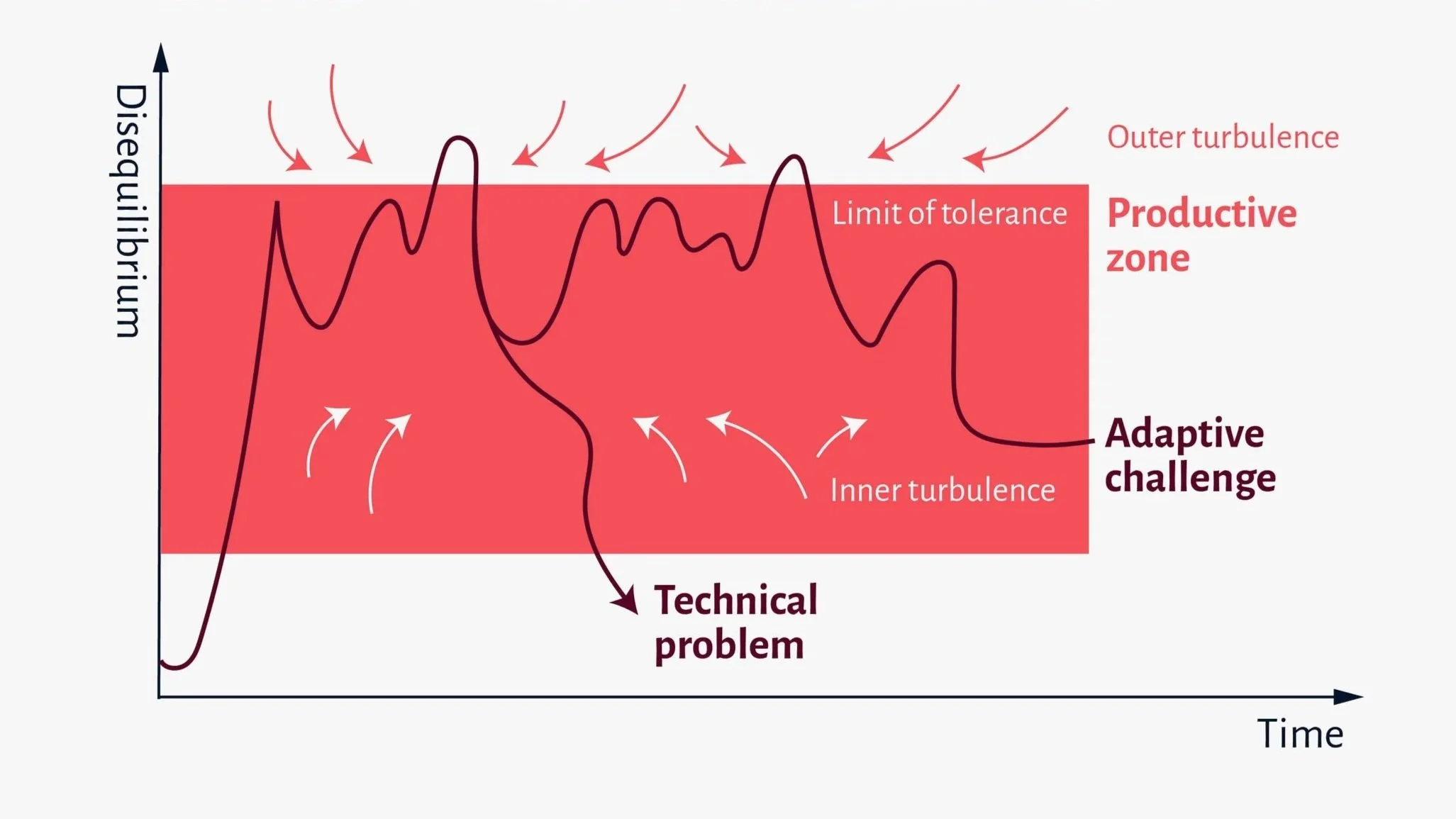
Illustration by Anna Denardin, adapted from Ronald A. Heifetz and Donald L. Laurie, "Mobilizing Adaptive Work: Beyond Visionary Leadership"
Turbulence is what the atmosphere does that neither the airplane engineers nor its pilots can administer away, but rather need to regulate around. Said another way, the ghost of turbulence is a system condition rather than its exception. The ghost resists the perfection of a stable flight. Aeronautical engineers and pilots understand their function is to navigate six types of technical bumps: roll (lateral balance), pitch (vertical balance), yaw (rotation), surge (speed), sway (drift), and heave (vertical drop). Describing turbulence to Bilger, the atmospheric scientist Bob Sharman said: “it’s not just one thing that’s going on. It’s not just atmospheric convection. It’s not just wind flowing over mountains. It’s everything going on all the time and interacting.” Does that condition sound familiar?
Pilots navigate through complexity with complexity. The Zone of Disequilibrium suggests that organizational leadership predicated on eliminating turbulence through management practice is counterproductive. Much like the pilot regulating around turbulence, adaptive leadership requires the skills and the stamina to stay in discomfort long enough to find a solution when one currently does not exist. Yet, the prevalent form of organizational leadership tries to manage disturbances by treating complexity as if it was predictable. As Herbert Simon summarized in his speech accepting the Nobel Prize in Economics, "decision makers can satisfice either by finding optimum solutions for a simplified world, or by finding satisfactory solutions for a more realistic world.” Before we get into what a different form of leadership looks like, it helps to understand the dynamics of turbulence and what it is doing to everyone on board.
In our diagnostic tool, we identified the following attributes that differentiate turbulence from other kinds of uncertainty:
Irregularity: it can shift extremely rapidly and non-linearly
Variability: it has a wide band of different intensities and predictability
Embodied: it registers in the body before the mind
These qualities are the same whether a pilot or a passenger. It doesn’t make a difference how well prepared you are, how much data you have access to, or what you previously experienced. These three qualities define everyone’s experience with turbulence and are the system's condition.
Taking inspiration from the actual training diagrams used by pilots, we created the following illustration that shows how degrees of turbulence are differently perceived by pilots and passengers based on their roles:
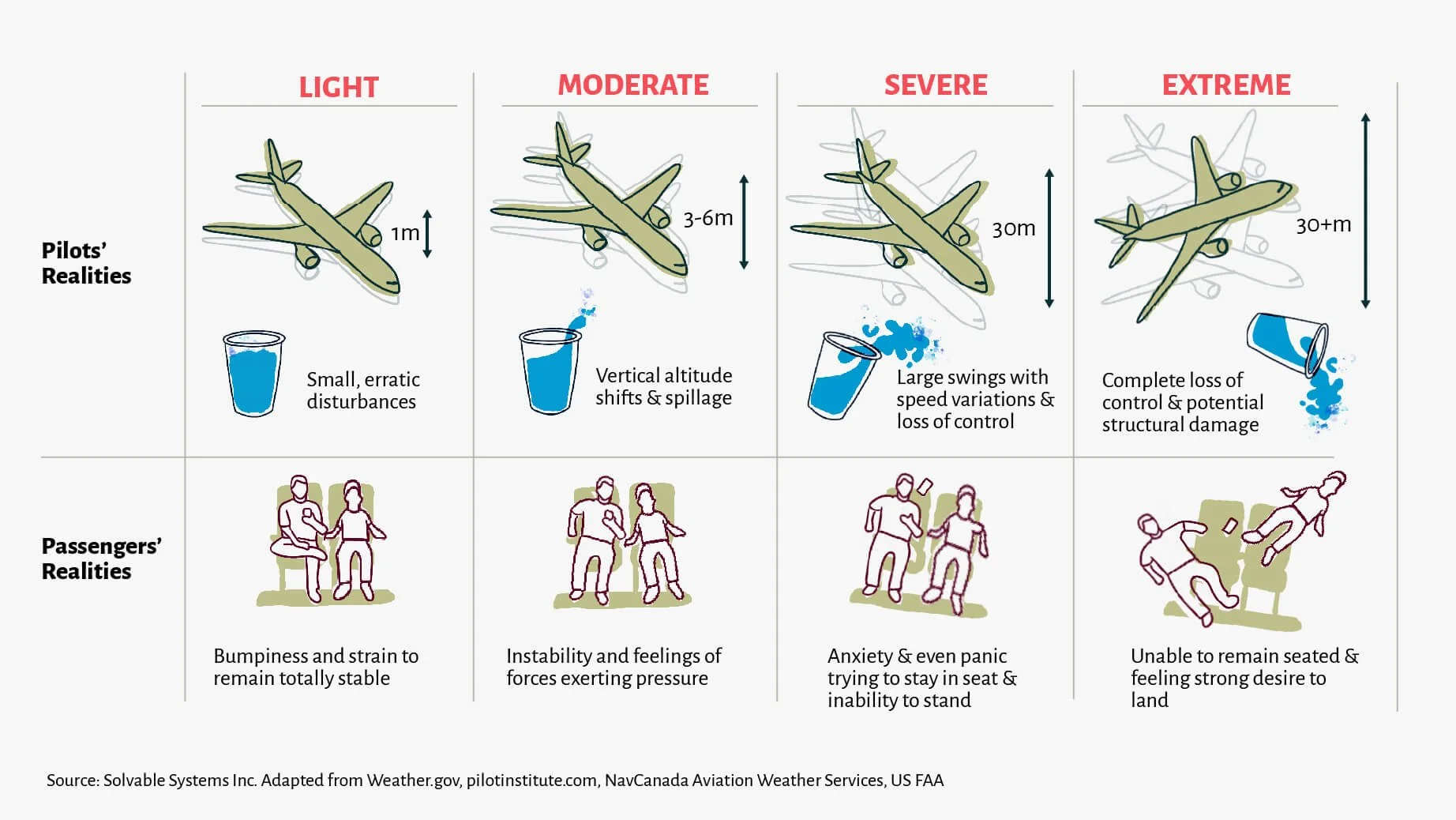
Illustration by Anna Denardin
Pilots share the same physiological experiences as passengers and rarely have one-hundred percent visibility into what is ahead and around. Their water glasses are subjected to the same physical forces as the passengers’ glasses in the cabin. However, pilots by and large experience turbulence psychologically differently than passengers (who often experience it differently than each other).
At their core, pilots anticipate turbulence, while passengers deny it. Pilots understand flying as unstable, while passengers assume stability. Fear is a good demonstration of the difference between the two groups. Pilots fear through what they know. Passengers largely fear the unknown. If a pilot has the inclination to land the plane, it is because all the data is telling them the situation is unmanageable. If a passenger desires for the plane to land, it is because they are confronting fear that they neither anticipated nor can anticipate what is ahead given their training and access.
The cockpit and the cabin share the same plane, but often not the same mindset. Closing that gap in organizational leadership is what the rest of the article addresses.
Passenger vs Pilot Mindset
Comparing the way a pilot envisions a flight versus an average airline passenger reveals dramatic differences. The pilot recognizes they cannot administer away turbulence, and generally the passenger chooses to ignore turbulence altogether until their water glass is rattling or they are flying out of their seat. The pilot and the passenger are often operating with entirely different cognitive frameworks.
Passenger Cognitive Framework
Flying is a binary (okay or catastrophic)
The anticipation is smooth air
The plan will be followed through from point A to B
The flight will arrive on time with a small margin of error
Turbulence is a threat
Endurance is potentially endless
Pilot Cognitive Framework
Flying is on a spectrum (within flight envelope to approaching limits)
The anticipation is variable air
The plan will be adapted in real time as needed
The flight will arrive when it can
Turbulence is managed risk (pushing the envelope)
Endurance is bounded with a forecasted end
Until now, you might assume that I am going to suggest that pilots = organizational leaders/education administrators and passengers = employees/faculty. I am loath to offer that loudspeaker announcement. First off, I don’t subscribe to the notion that those with leadership titles are the ones solely responsible for leadership. However, in most organizations, named leaders seem to navigate turbulence with the mindset of airline passengers: they create a linear strategy, implement through binaries, and refuse to acknowledge and adapt to rapidly changing conditions despite having the instruments.
The questions I am holding are:
Whether organizational leaders are performing as a passenger in ways they think will appease superiors, team members, and stakeholders while actually thinking and navigating like a pilot?
In an era of rapidly accelerating external turbulence, are organizational leaders aware of the risk factors in often turning a blind eye to the inner turbulence of their departments?
The irony is that those often acting as pilots in their organization are more often those without leadership titles who acutely feel the somatic effects of both external and internal turbulence. They are often not riding in the same air cabin as their titled leaders who are sequestered in the cockpit. These employees, faculty, and staff are more attuned to the turbulence ahead by noticing what is happening to the colleagues around them while also looking out the small window. The reality is that many organizations are currently flying with navigational intelligence in the wrong seats. Recognizing which seat you are actually in is where the adaptive leadership journey begins.
Photo by Felipe Vidal Soto on Unsplash
Tolerance-Interval Thinking
Turbulence is inversely correlated with adaptation in many organizations. The more turbulence, the more likely individuals, teams, departments and even entire organizations are to be approaching or even stepping out of the emergency exit. In organizational contexts, this behaviour is manifest through shifting work to simplify the complex, predict the uncertain, ignore signals of variance, and shorten the time to solve. It is also manifested psychologically through dissent, disengagement, repairing disfunction, and even quitting (quietly or loudly). Both the work behaviours and the psychological processes could be classified as turbulence risk for organizations and their leaders.
It is not only wishful but also irresponsible thinking to operate as if the air is clear and more of it is ahead. We no longer live in a pre-1979 atmosphere of turbulence nor will it return, new ways of working with the complexities and uncertainties of the world are needed. I am calling this tolerance-interval thinking to incorporate the limits proposed by the Zone of Disequilibrium. Instead of assessing solely about whether the organization is within the productive Zone or outside it, tolerance-interval thinking proposes different leadership orientations based on adaptation to the turbulence interval. This way of thinking could shift questions like what will happen and how do we plan for it, to ones like:
What range of conditions must our strategy remain viable across?;
Are we presently within the anticipated interval, and how will we know when we have fallen out of it?; and
How is turbulence within this interval being experienced differently by colleagues, and how might tactics and strategies need to adapt?
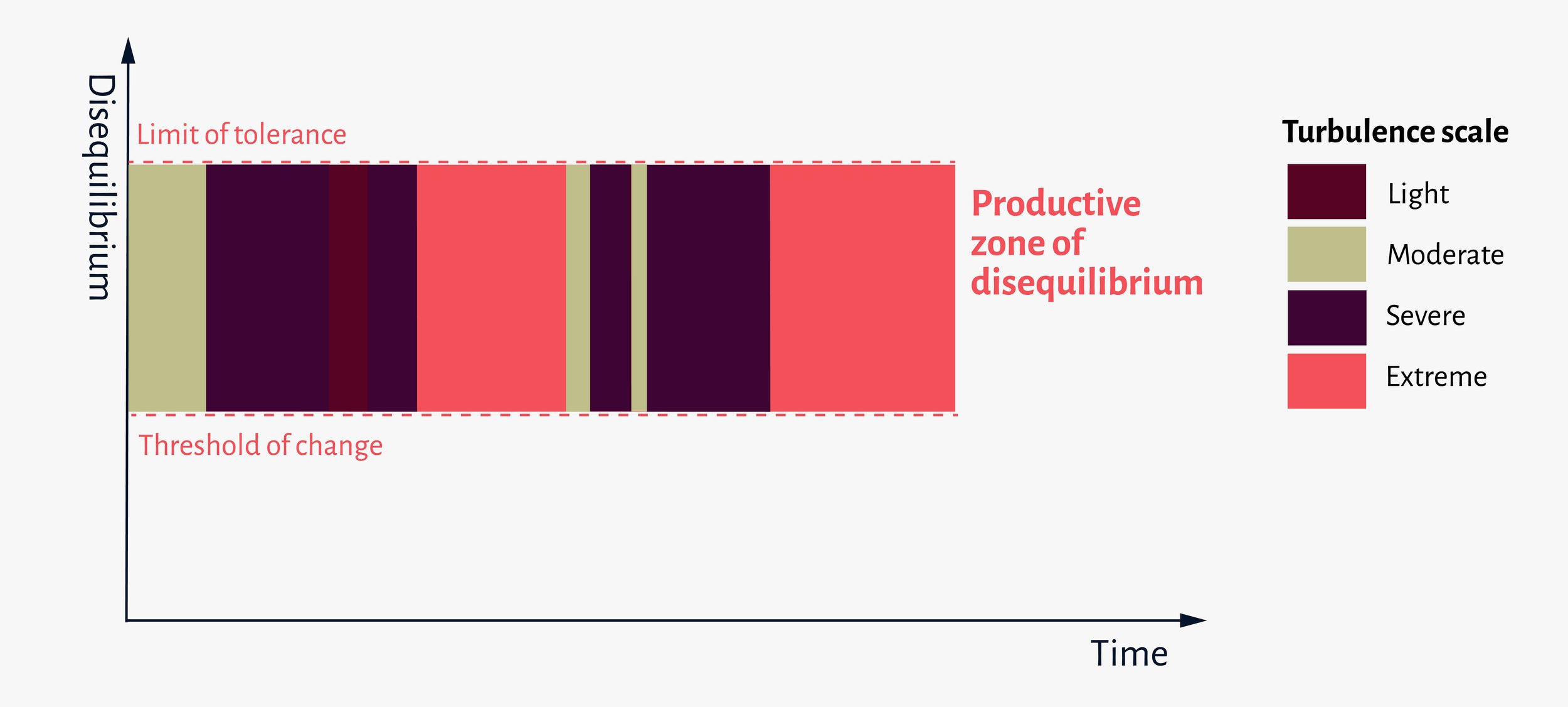
Illustration by Anna Denardin, adapted from Ronald A. Heifetz and Donald L. Laurie, "Mobilizing Adaptive Work: Beyond Visionary Leadership"
This is not to suggest that a reasonable limit of tolerance exists. Sitting in ambiguity over long durations with the simultaneous need to develop new skills, tools, techniques, and relations requires new approaches.
As Linsky’s work exposes, the challenge of adaptive leadership is how to productively function during times of disequilibrium rather than stability. What were once mostly simple, complicated technical problems have become adaptive, complex cultural ones. What we are wrestling with in today’s organizations is what emerges from the system’s own complexity. The cybernetic concept of requisite variety suggests that a system needs as much internal complexity as the environment it lives within. No matter how sophisticated the machine, it is never separate from the complexity of the world in which it functions. Leadership often proceeds as if it could.
CONCLUSION
Outer turbulence haunts the passenger mindset of leadership. Inner turbulence haunts the pilot. Perhaps the difference between pilots and most organizational leaders is that the former have trained for and anticipate the arrival of the turbulence ghosts, whereas the latter seem to await smooth air to make bold strategic moves.
It would be a mistake to confuse a plan with the future, and to assume managing the ghosts is a task to be undertaken only by those in positions of so-called leadership. Part of working with the complexity of the system is to work complexity of the world they are experiencing. So rather than view this as a binary of pilots who lead and passengers who fly, tolerance-interval thinking suggests closer proximity to the inner and outer turbulence. The viewing window for many is often kept devastatingly small, and could be considerably widened. Doing so is less a structural change than a cultural one. Organizations that travel with the variability of air currents end up developing adaptive capacities much deeper than what traditional hierarchy privileges.
Adaptive leadership offers that the future is not something that can be fully understood or planned. Rather, the future will be filled with complexity and uncertainty. Inner and outer turbulence pose quantifiable risk to organizations. The future is a distribution to be navigated in real time. The pilot doesn't need to exorcise the turbulence ghost; they've learned to fly with it. The same could be said for organizational leadership. The opportunity is to learn to plan with and adapt to the complexity of the actual world outside and inside the plane rather than continuing to reduce it.
Are we within our envelope, and do we know how close we are to its limits?
Now that’s a pilot question.
In addition to the authors cited above, I am indebted to the thinking and writing of many that I have been in conversation with, and also many that I haven’t such as W. Ross Ashby (requisite variety), Herbert Marcuse (administered society), Herbert Simon (satisficing), Nassim Nicholas Taleb (uncertainty), and Kyle Whyte (coordination epistemology).
Claude.ai was used as a copy editor. Any faults in this article are my own.
An Invitation
If this article poses the kinds of questions you’d like to think more about in your leadership role, we'd welcome you to attend one of our April webinars. They are invitation-only sessions designed to build adaptive leadership skills and strategies you can bring back to your team and faculty. April 1st is designed specifically for higher education senior administrators. April 16th is open to organizational leadership in any sector.